| |
Details

D120
Grape
D120
Apricot
- Watch - |
|
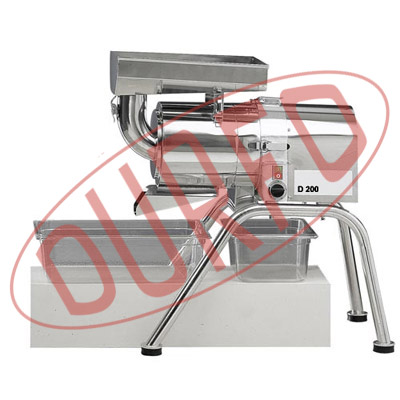
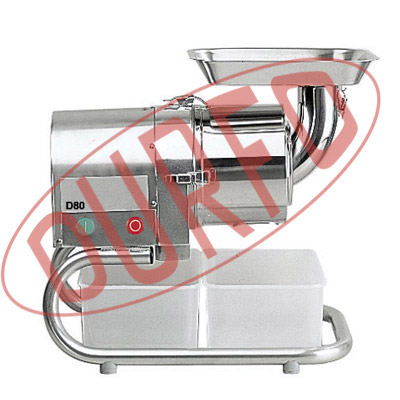
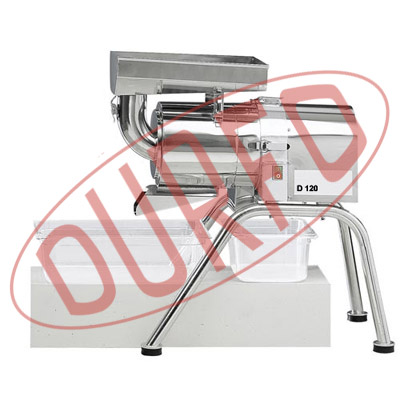
The model we make today are three ( a bench version and two floor versions) and they grow according to the power and according to the loading capacity.
This machine are used above all for fresh fruit purée production, in the preserving laboratory,for a lot of dishes and gastronomic preparations ( often for tomato), in hospital to refine cokked fruit,
in restaurants to strain fish soups and some other. The machine is able to separate admirably the pulp and food juice ( only if tender and cooked) from everything that can be considered rejects ( ex. with fish soup , the pulp and the sauce from bones and shells).
The body of the reifne pulper is completely movable and dismountable to facilitate the washing.
Induction motor
Asynchronous motor with long length guarantee installed on bearings for a max silent of work
No maintenance
Steel Motor shaft
Operation system
A group with two shovels, fixed in contact with the motor, turning at 1500 turns/min, break up and spread quickly on the inox pierced basket the fruits or whatever is put through the loading tray, separating immediately th pulp from the rejects. scarto.
The loading tray on which are put the food to be treated, has a great hole through which fall the products to be directed toward the sifting room.
The expulsion opening of the product drops in an apposit container ( it is equipped) the refined product free from rejects such as pips, stones, skins and other impurity.
A second expulsion opening drops in another container ( already equipped) the reject due to the working. If the results to the first passage is not sufficient, you can refine once more the rejects to squeeze totally the original food so reducing every rejects.
TECHNICAL DATA REFINE PULPER D200 :
• Power 2.4HP 1.80 Kw
• Feeding 230/400V 50Hz
• Speed 1500 tunrs/min
• Production 150kg/hour
• Floor version
• Dimension L860mm x w480mm x H840mm.
• Weight 41kgs
TECHNICAL DATA REFINE PULPER D120 :
• Power 1.2Hp 0.9Kw
• Feeding 230/400V 50Hz
• Speed 1500 turns/min
• Production 120Kg/hour
• Floor version
• Dimensions L860mm x W480mm x H 840mm
• Weight 40kgs
TECHNICAL DATA REFINE PULPER D80 :
• Power 0.85HP - 0.65Kw
• Feeding 230V 50Hz
• Speed 1500 turns/min
• Production 50kg/hour
• Bench version
• Dimensions L570mm x W 260mm x H 460mm
• Weight 21kgs. |
|